CBO: US Federal deficits and debt to worsen over next decade
The nonpartisan Congressional Budget Office’s 10-year outlook projects worsening long-term United States federal deficits and rising debt, driven largely by increased spending, notably on Social Security, Medicare, and debt service payments.
Compared with the CBO’s analysis this time last year, the fiscal outlook, which was released on Wednesday, has deteriorated modestly.
Recommended Stories
list of 4 itemsend of list
The CBO said that the deficit for fiscal 2026 – President Donald Trump’s first full fiscal year in office – will be about 5.8 percent of GDP, about where it was in fiscal 2025, when the deficit was $1.775 trillion.
But the US deficit-to-GDP ratio will average 6.1 percent over the next decade, reaching 6.7 percent in fiscal 2036 – far above US Treasury Secretary Scott Bessent’s goal to shrink it to about 3 percent of economic output.
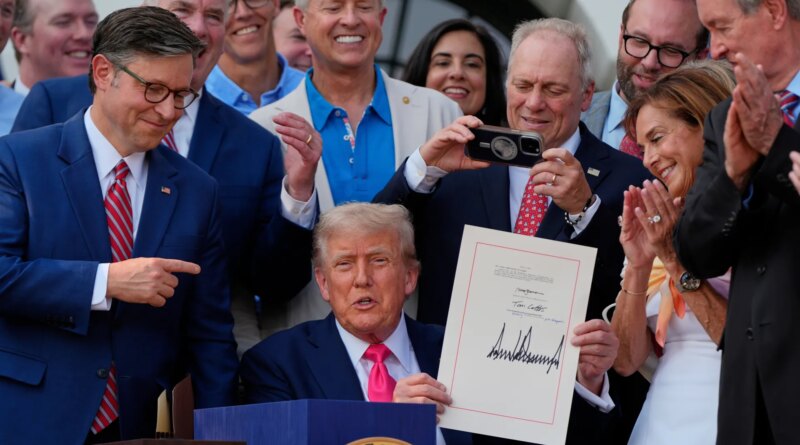
Major developments over the last year are factored into the latest report, including Republicans’ tax and spending measure known as the “One Big Beautiful Bill Act,” higher tariffs, and the Trump administration’s crackdown on immigration, which includes deporting millions of immigrants from the US mainland.
As a result of these changes, the projected 2026 deficit is about $100bn higher, and total deficits from 2026 to 2035 are $1.4 trillion larger, while debt held by the public is projected to rise from 101 percent of GDP to 120 percent — exceeding historical highs.
Notably, the CBO says higher tariffs partially offset some of those increases by raising federal revenue by $3 trillion, but that also comes with higher inflation from 2026 to 2029.
Rising debt and debt service are important because repaying investors for borrowed money crowds out government spending on basic needs such as roads, infrastructure and education, which enable investments in future economic growth.
CBO projections also indicate that inflation does not hit the Federal Reserve’s 2 percent target rate until 2030.
A major difference is that the CBO forecasts rely on significantly lower economic growth projections than the Trump administration, pegging 2026 real GDP growth at 2.2 percent on a fourth-quarter comparison basis, fading to an average of about 1.8 percent for the rest of the decade.
Trump administration officials in recent weeks have projected robust growth in the 3-4 percent range for 2026, with recent predictions that first-quarter growth could top 6 percent amid rising investments in factories and artificial intelligence data centres.
CBO’s forecasts assume that tax and spending laws and tariff policies in early December remain in place for a decade. The government’s fiscal year starts on October 1.
While revived investment tax incentives and bigger individual tax refunds provide a boost in 2026, the CBO said that this is attenuated by the drag from larger fiscal deficits and reduced immigration that slows the growth of the labour force.
Jonathan Burks, executive vice president of economic and health policy at the Bipartisan Policy Center said “large deficits are unprecedented for a growing, peacetime economy”, though “the good news is there is still time for policymakers to correct course.”
‘Urgent warning’
Lawmakers have recently addressed rising federal debt and deficits primarily through targeted spending caps and debt limit suspensions, as well as deploying “extraordinary measures” when the US is close to hitting its statutory spending limit, though these measures have often been accompanied by new, large-scale spending or tax policies that maintain high deficit levels.
And Trump, at the start of his second term, deployed a new “Department of Government Efficiency”, which set a goal to balance the budget by cutting $2 trillion in waste, fraud and abuse; however, budget analysts estimate that DOGE cut anywhere between $1.4bn to $7bn, largely through workforce firings.
Michael Peterson, CEO of the Peterson Foundation, said the CBO’s latest budget projection “is an urgent warning to our leaders about America’s costly fiscal path.”
“This election year, voters understand the connection between rising debt and their personal economic condition. And the financial markets are watching. Stabilising our debt is an essential part of improving affordability, and must be a core component of the 2026 campaign conversation.”