Electricity Learnings From Great Freeze Of January 2026 In U.S.
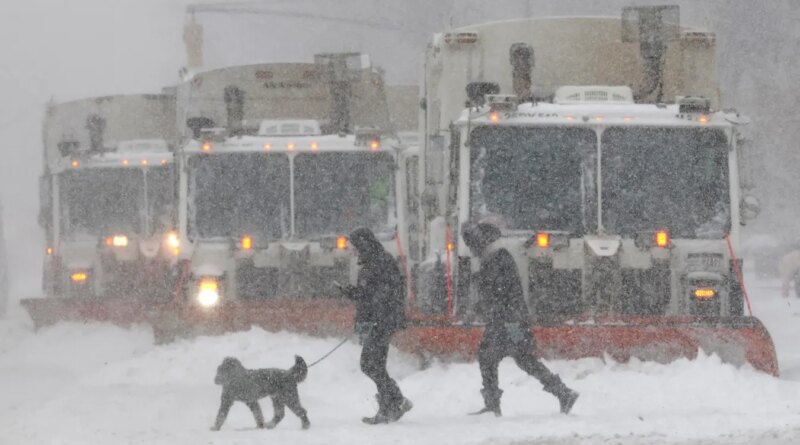
People cross a street as trucks plow snow in the Manhattan borough of New York City on January 25, 2026.
AFP via Getty Images
A major winter storm called Fern hit the U.S. from January 23 to January 27, 2026. Fern caused great disruption in electrical power sources, and may be a harbinger of things to come. According to AccuWeatherpower outrages reached 1,000,000 customers (yes that’s one million) on January 23, falling to 550,000 on January 27. Ten days later, on February 2, the number was still 200,000 customers without power.
Conditions worsened in the southeast. A million homes lost power from Arkansas to Tennessee because freezing precipitation broke tree limbs that snapped power lines—not the fault of power sources. What can we learn from all this?
Five years ago, a catastrophic winter storm called Uri hit Texas in the period February 11-20 of 2021. The worst storm in Texas historyit led to 246 deaths, and cost almost $200 billion in damages. The storm was 4 minutes away from collapsing the state grid, managed by ERCOT, for a month. To avoid this, rolling blackouts were imposed, leaving 4.5 million homes and businesses without power for days. Perhaps 10 million people were without power at the storm’s peak.
Not So Bad In Texas.
Things weren’t as bad in Texas as they were in 2021. The storm didn’t last as long, and power plants had been insulated better. Also, large grid batteries which are growing fast in Texas can provide instant power to deflect imminent outages. You can’t get this quick response from other sources.
Natural Gas Issues In Mid-Atlantic Region.
The North American Electric Reliability Corporation, or NERC, sets electric grid reliability standards for the U.S. Jim Robb, president, acknowledged that gas-fired power plants were limited by gas supply due to freezing weather in states further east. This was a big problem for the grid that covers much of the mid-Atlantic, called the PJM interconnection. Robb suggested PJM was short of power by 20 Gigawatts (GW) due to freezing issues or fuel shortages.
He also said that gas prices were pushed much higher by the conditions, and this forced electricity prices up. This means a long-term problem for utilities that have to recover costs, and inflation anxiety for consumers. Note: gas pipelines and wellheads did not freeze in 2026, but they did in 2021 which caused substantial problems.
Electrical Grid Stability:
All this touches on the stability of electrical grids, which is vital for U.S. energy security. Jim Robb says that as demand for power increases, due to AI for instance, grid stability needs to increase too. But the safety cushion is becoming less, as winter storm Fern demonstrated, when grid operators had to use every tool in their toolbox to keep power going.
In a timely coincidence, just last week NERC published their long-term outlook for grid stability: 2025 Long-Term Reliability Assessment (LTRA). A broad-brush summary warned that the U.S. needs to boost grid stability by hefty investments in first, electrical generation and transmission; second, improved cold weather readiness; and third, better standards for natural gas contracts and deliverability.
The report attributes most of the increased demand to data centers, AI, and the digital economy, but also lists “large industrial facilities, electrified transportation, crypto mining, heat pump deployment.” But the enduring message of the report is that supply growth will not keep up to surging demand.
Out of 23 assessment regions across the U.S., 13 will face deliverability challenges over the next five years. 5 of these 13 are at high risk: MISO, PJM, ERCOT, and WECC.
“The regions facing the highest risk are contending with steep load growth that consistently outpaces planned resource additions, particularly as thermal retirements mount and solar-heavy additions introduce variability,” states the report. The impediments are identified as coal-fired power plants to be retired, and solar renewables that don’t function at night time, and work poorly in winter season. The report goes on to say that solar PV plus batteries are two-thirds of capacity under development in the U.S.
This, I believe, is an over simplification for three reasons: one, many coal-burners are old and coal burns to particulates in air that promote asthma in children and elderly. Two, solar and grid batteries are cheaper and faster to install than gas-fired turbines, on a lifetime basis. This is why solar/wind and batteries have provided about 90% of all new U.S. power over the last two years. Three, grid batteries are expanding rapidly and are able to make solar power more dispatchable by switching daytime power to storage for night time use.
From Scenarios To Actualities.
The NERC report should be embraced and dissected. It serves as a warning for the generation of electrical power to meet the needs of data centers and AI over the next ten years. But one shortfall is failing to list positives of renewables plus grid batteries that currently supply 90% of new power in the U.S., but which have been handicapped by the Trump administration that supports fossil fuels and other advanced technologies which are too little and too late (read nuclear and geothermal).
One actuality is the Permian Basin, the premier oil and gas basin in the U.S. Xcel Energy, a utility that provides power to southern New Mexico and West Texas, says power demand is up, driven by new data centers, oil and gas industry, and nuclear manufacturing. Xcel are deeply concerned that growing power demand will outstrip power supplies by as much as 20 GW by 2035.
The report on this is sobering for the following reasons. Xcel is already suffering a major power shortage, mainly for oil and gas, but also for data centers, agriculture, nuclear, and U.S. defense. In 2023, 14 power projects identified for build-out would cost $9 billion. If renewables replaced the gas-fired plants the cost would go up by 60%. To clarify, these are build-out costs, not lifetime (LCOE) costs when solarPV plus batteries are lower than gas-fired turbines.
Mewbourne Oil gets 168 Megawatts (MW) for its oilfields from Xcel, but the company wants another 233 MW. This is now being supplied by 300 small gas generators. The company is on the waiting list, but figure they’ll have to fill their own supply gap for another ten years.