Donald Trump says US ‘looking’ at military operations in Iran
Unlock the White House Watch newsletter for free
Your guide to what Trump’s second term means for Washington, business and the world
US President Donald Trump said he is considering conducting military operations in Iran, as he warned the Islamic republic is starting to cross his red line amid an intensifying crackdown on nationwide protests.
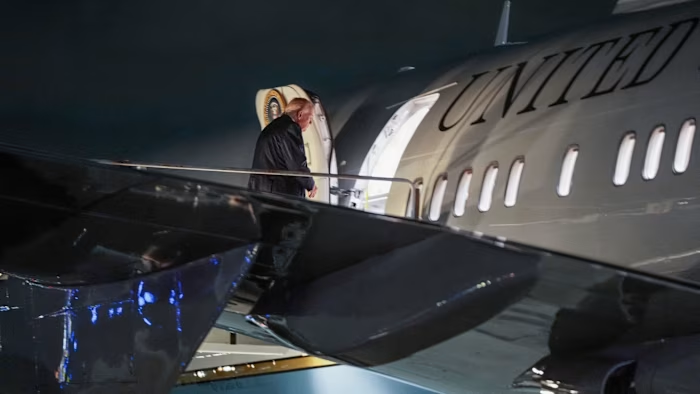
The military “is looking at it, and we’re looking at some very strong options”, Trump said aboard Air Force One on Sunday, en route to Washington from Florida.
Asked if Iran has crossed his red line for intervention, Trump replied that “they’re starting to, it looks like”. He added that he would “make a determination” and that “we’re looking at [the situation in Iran] very seriously”.
Trump has said repeatedly that the US is ready to “rescue” Iranians if the authorities there kill protesters as weeks of unrest pose the greatest domestic threat to the Islamic regime in years. On Friday he said he would “hit” Iran “very hard where it hurts”.
The US president said that Iranian leadership called on Saturday, and that they want to negotiate with Washington. The US and Iran were working to schedule a meeting, but Trump said Washington might intervene before any session can take place.
“I think they’re tired of being beat up by the United States,” he said. “A meeting is being set up but we may have to act because of what’s happening before the meeting.” He added that the US was also in touch with Iranian opposition leaders.
Trump said he was receiving an hourly report on Iran, adding that “there seem to be some people killed that aren’t supposed to be killed” throughout the country.
He said the protesters were “under siege, and now it looks like they’re being shot”, as well as killed in stampedes.
Activist groups have estimated that between 200 and 500 people have been killed since the protests in Iran erupted in late December, including dozens of members of the security forces, with thousands detained.
Videos posted online purported to show protesters continuing to take to the streets on Sunday. It was not possible to verify the information due to Iran’s internet blackout.
Trump added that his administration was discussing the near-total blackout, which went into effect on Thursday, and that Washington could move to “get the internet going” if possible. Trump said he would call Elon Musk, who owns the Starlink satellite broadband network, to discuss Iran.
Washington has not deployed additional troops or jets to the region so far, and the US is also without an aircraft carrier in the area, officials said. The USS Gerald R Ford, the largest and most advanced aircraft carrier, left the Mediterranean in November for the Caribbean to focus on Venezuela.
The US had six warships, including three guided-missile destroyers, in the Gulf as of January 5, according to a tracker from the US Naval Institute.
Iranian President Masoud Pezeshkian on Sunday said the government would “sit and listen” to people’s concerns, but also blamed “rioters” and the US and Israel for stoking the protests.
“It is our responsibility to solve their concerns,” he said in an interview on Iranian television. “But the higher responsibility is to not allow a group of rioters to come and destroy the entire society. These are not people. They are not from this country.”
Iran’s parliament speaker Mohammad Baqer Ghalibaf on Sunday warned the US against “a miscalculation”. He told lawmakers: “Let us be clear: in the case of an attack on Iran, the occupied territories [Israel] as well as all US bases and ships will be our legitimate target.”
The demonstrations were triggered by economic grievances — including Iran’s plunging currency — as shopkeepers protested against soaring prices. Those protests have since turned into nationwide anti-regime demonstrations.
The US has fewer than 40,000 troops and military personnel in the Middle East. It operates eight permanent bases in Bahrain, Kuwait, Qatar and the United Arab Emirates and has access to 11 additional military sites, including in Egypt, Iraq, Jordan, Oman, Saudi Arabia and Syria.
The biggest US base is Al Udeid Air Base in Qatar, where US Central Command, which is responsible for military operations throughout the Middle East, has its regional headquarters. In June, Tehran fired missiles at Al Udeid in retaliation for the US bombing Iran’s main nuclear plants.
Trump said that should Iran retaliate against any military action by attacking US bases, Washington would hit “targets they wouldn’t believe. If they do that, we will hit them at levels they’ve never been hit before.”
Karoline Leavitt, White House press secretary, said on Sunday that Trump had been “considering many options for days” regarding Iran and a meeting with senior advisers had been scheduled for Tuesday.
Additional reporting by James Politi in Washington and Andrew England in London