
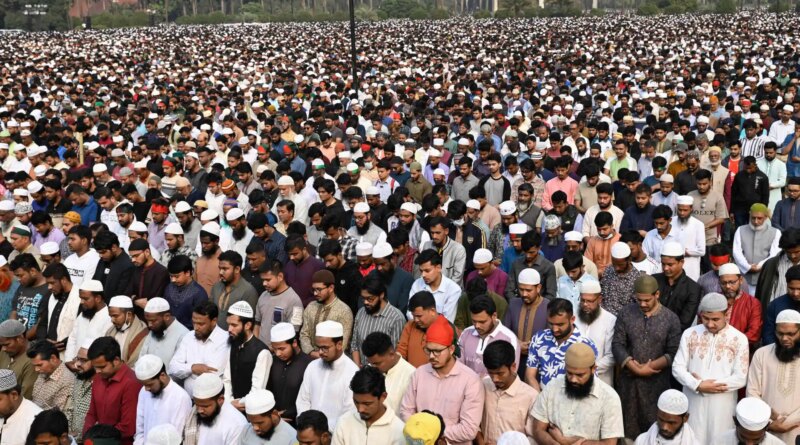
Bangladesh holds state mourning, funeral for slain uprising activist
Bangladesh is observing a national day of mourning as the funeral was held for Sharif Osman Hadi, a prominent leader of its 2024 student-led uprising, after his death triggered two days of protests across the country.
Tens of thousands of people poured into the area surrounding Bangladesh’s parliament house in the capital, Dhaka, before Hadi was buried at the Dhaka University’s central mosque.
Recommended Stories
list of 4 itemsend of list
He was laid to rest next to the national poet Kazi Nazrul Islam.
“You are in our hearts, and you will remain in the heart of all Bangladeshis as long as the country exists,” interim leader Muhammad Yunus told the crowd in a speech.
Dhaka University officials and high-profile political figures were also in attendance, newspaper The Daily Star reported, including the leader of Hadi’s Inqilab Moncho movement and the National Citizen Party chief.
Police wearing body cameras and security forces were deployed across Dhaka to manage traffic and control crowds during the proceedings. The Bangladeshi flag was flown at half-staff at all public and private buildings to mark the day of mourning.
Although protests had largely cooled off by Saturday, the interim government announced the arrests of seven people suspected in the death of Dipu Chandra Das, a 27-year-old Hindu man, in what the government has called a “lynching” in Mymensingh on Thursday.
Media also continued to report previously unknown incidents of violence as cultural institutions, newspapers and political buildings reeled from arson attacks and mob rushes earlier in the week, in the latest turbulent chapter in the nation’s recent history.
Daily newspaper Prothom Alo reported that the home of Anisul Islam Mahmud, president of the National Democratic Front party and chairman of a faction of the Jatiya Party, was vandalised and set on fire at about midnight on Friday in Chattogram, Bangladesh’s second-largest city.
Bangladesh Shilpakala Academy, the country’s main state-sponsored cultural centre, announced it would suspend all programming and exhibitions, The Daily Star said. The group cited security risks following arson attacks on Thursday on two of its organisations’ buildings.
Both Prothom Alo and The Daily Star were also targets of ambushes that trapped dozens of employees inside and forced them onto the roof as flames engulfed the building of the latter. The publications pledged to keep publishing online, however.
Hadi, the 32-year-old spokesperson for Inquilab Moncho, or Platform for Revolution, died in hospital in Singapore on Thursday after being shot in the head more than a week ago by masked attackers.
Inqilab Moncho urged people on Facebook to participate in the leader’s funeral, after earlier calling on its followers to refrain from carrying out acts of violence.
Aside from being Inqilab Moncho’s spokesperson, Hadi was planning to stand as a member of parliament for the Dhaka-8 constituency in the Bijoynagar area of the city in the upcoming elections, slated for February 2026.
But on December 12, he was shot in the head by two assailants on a motorcycle that drew up alongside the battery-powered auto-rickshaw he was travelling in.
After three days of treatment at Dhaka Medical College Hospital, Hadi was transferred to Singapore General Hospital for treatment of brain stem damage. He died on Thursday evening, kicking off Bangladesh’s latest round of mass protests.
Although several arrests were made in connection with his death, “the killer may have – at least, from speculations made by police and others – escaped to India through the border,” Al Jazeera’s Tanvir Chowdhury reported from Dhaka. Hadi and Inqilab Moncho were outspoken critics of India.
The prospect of the killer’s flight – along with frustrations over the harbouring of former Prime Minister Sheikh Hasina by India – created “a strong anti-India sentiment” in the crowds that began pouring into the streets in the cities of Dhaka, Rajshahi, Chittagong and Gazipur on Thursday evening.
Demonstrators torched the home of Hasina’s assassinated father Sheikh Mujibur Rahman, bulldozed the office of her party, the Awami League, and blocked various highways. Groups also attacked the Indian Assistant High Commission in Chittagong, while the Prothom Alo and Daily Star newspapers were reportedly attacked for pro-India sympathies.
Bangladesh’s interim government, which has been led by Nobel Peace Prize laureate Muhammad Yunus since Hasina’s ousting in August 2024, “strongly and unequivocally” condemned the violence, including Das’s killing.
By Friday afternoon, as Hadi’s body was repatriated from Singapore, protesters poured into Dhaka’s Shahbag Square and called for the extradition of all those linked to Hadi’s death, and Hasina.
They said protests would continue until “Sheikh Hasina and all those responsible for killings are returned”, one activist told Al Jazeera.
In November, Hasina was sentenced to death by hanging after she was found guilty of crimes against humanity for ordering a deadly crackdown against the student-led uprising that ousted her. The United Nations says 1,400 protesters were killed and thousands were injured in the weeks of violence, as her government desperately sought to cling to power.
Shaina Begum, the mother of 20-year-old student Sajjat Hosen Sojal, who was shot and whose body was burned by the police hours before the student-led uprising forced Hasina to resign and flee the country, told Al Jazeera after the verdict, “I cannot be calm until she [Hasina] is brought back and hanged in this country.”
Hundreds of families who lost loved ones in the protests wonder if the deposed prime minister will ever face justice.


