
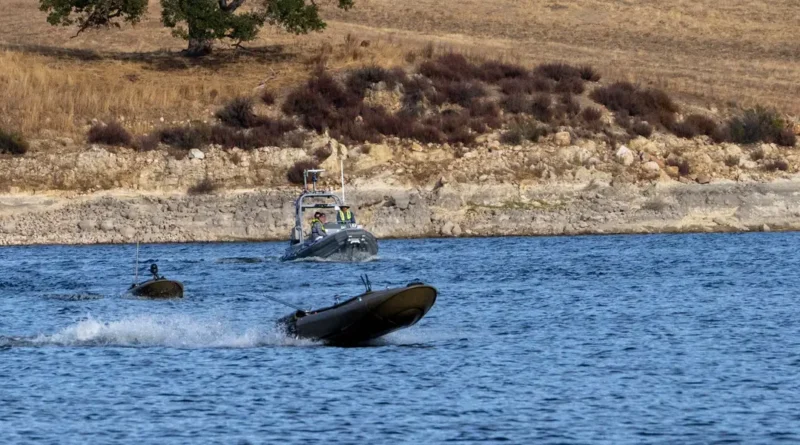
The US Navy wants drones to work alongside warships. Sometimes they're better off on their own, defense analysts say.
The US Navy wants naval drones to help its crewed warships do more, but a new report argues that making them work together might not always be the best approach.
Sometimes, drones might prove more useful on their own, defense analysts wrote.
The US military has experimented with crewed-uncrewed teaming for years, focusing on how uncrewed systems can complement crewed naval elements by extending reach, sensing, and firepower. But forced manned-unmanned teaming can limit their biggest advantages, specifically their flexibility and the ability to take risks that humans can’t.
In a new report from the Hudson Institute think tank, authors Bryan Clark, David Byrd, and Dan Patt analyze the Navy’s plan to grow the fleet, proposing a more affordable design and structure that adapts to new threats and embraces emerging technologies.
Discussing a new theory of victory for the Navy, the authors argue that pairing crewed and uncrewed platforms “tend to suboptimize both the manned and unmanned components of the team and fail to exploit the advantages of each.”
For example, uncrewed ships could carry additional munitions for crewed vessels, but limitations in speed, range, and protection could demand more frequent refueling and the use of defensive escorts, potentially defeating the purpose of using a naval drone in the first place.
Furthermore, drones that aren’t equally low-observable could compromise nearby stealthier platforms, while fixing that could get expensive, sacrificing their affordability.
Meanwhile, deploying drones alongside crewed warships could undermine the ability to quickly modify and adapt the uncrewed systems.
“Manned platforms cannot change sensors, EW [electronic warfare] systems, C2 [command and control] software, or weapons quickly because engineers need to assess the impact on safety and other systems,” the report says.
Autonomous systems can be modified much faster but could be subject to the same limitations if operating nearby.
Clark, Byrd, and Patt provided several real-world examples that demonstrate how uncrewed technologies can operate as independent units. Over the past year, for instance, Ukrainian troops have expanded their use of uncrewed ground vehicles (UGVs) for logistics and medical evacuations, as well as engineering and fire support.
Dmytro Smolienko/Ukrinform/NurPhoto via Getty Images
“These operations deliberately use unmanned systems for operations or in places where the Ukrainian commanders do not want to risk human troops, increasingly producing a human-free front line,” the authors write.
In less-contested environments, soldiers and ground robots can work together, but communications problems, difficult terrain, and the need to refuel and repair robots can complicate operations, potentially putting accompanying troops at risk.
The authors argue that the more hands-off approach to uncrewed systems could help the US military counter a Chinese invasion of Taiwan.
According to the Hudson report, recent Navy Integrated Battle Problems examining a potential Chinese invasion have experimented with using autonomous systems in ways that draw on lessons from Ukrainian, Iranian, and Houthi operations.
“By attacking troop transports and their escorts with drone boats, undersea vehicles, and loitering munitions, a force of mostly RAS [robotics and autonomous systems] could slow or disrupt the invasion. This would give US and allied forces targeting information and time to destroy PLA [People’s Liberation Army] ships with long-range missiles and torpedo fires,” the authors write.
US military officials have also explored using large numbers of drones to disrupt Chinese invasion forces in the Taiwan Strait. Adm. Samuel Paparo, the head of US Pacific Command, has referred to it as an “unmanned hellscape” that would effectively act as a first line of defense and buy US, allied, and partner forces time to respond.
Clark, Byrd, and Patt’s observations come as the US military figures out the roles of uncrewed systems and autonomy and when it’s better to use them together with crewed assets or independently. The Navy has looked at drone boats for port security and also used them for rescue and attack missions in the Middle East.
The Hudson report’s argument isn’t that drones should never work alongside crewed ships, but the Navy could get more out of them by giving them missions that take advantage of what they can do on their own.