
Chipotle is using AI to hire in four days, plan food prep, and free managers from tedious work
Arlie Sisson is one of the most interesting executives I’ve met who’s actually putting AI to work in the real world.
Sisson is chief digital officer of restaurant chain Chipotle. I met her recently at a dinner hosted by Snowflake CEO Sridhar Ramaswamy, whose company supplies some of the technology Chipotle uses.
Sisson was the center of attention that evening. While plenty of executives are still talking about what AI might eventually accomplish, she shared fascinating examples of what it’s already doing.
And they involved guacamole. What’s not to like?
Chipotle
I followed up with Sisson for a longer interview to understand how Chipotle is using AI, what it’s getting in return, and what this means for the thousands of people who run its restaurants.
The answer is encouraging, because it shows this technology is helping workers be more human, not less. AI is taking over some of the tedious work of running a restaurant, giving managers more time to do what humans are particularly good at.
Chipotle has three main projects underway. One is already producing results. Another is expanding rapidly. A third could change how restaurant managers organize their days.
Hiring employees quicker
Let’s start with the clearest evidence.
Hiring employees is a big job when you operate thousands of restaurants. Managers have to review applications, communicate with candidates, arrange interviews, collect paperwork, and get new employees ready to start.
Chipotle has an AI assistant called “Ava Cado” that handles much of this work.
Ava communicates with applicants in multiple languages, answers questions, gathers information, schedules interviews, and helps move candidates through the hiring process.
The results are striking.
Before Ava, the average time between someone applying for a job and starting work was 12 days. Now it’s four.
That’s eight days eliminated from the hiring process.
The number of applicants coming through has nearly doubled, while the proportion who complete their applications has jumped from about 50% to almost 88%.
These are meaningful improvements for a company that constantly needs to recruit employees across more than 4,200 restaurants.
And this frees managers from spending so much time chasing paperwork and coordinating interviews.
“At our scale, that’s meaningful,” Sisson told me.
How much guacamole?
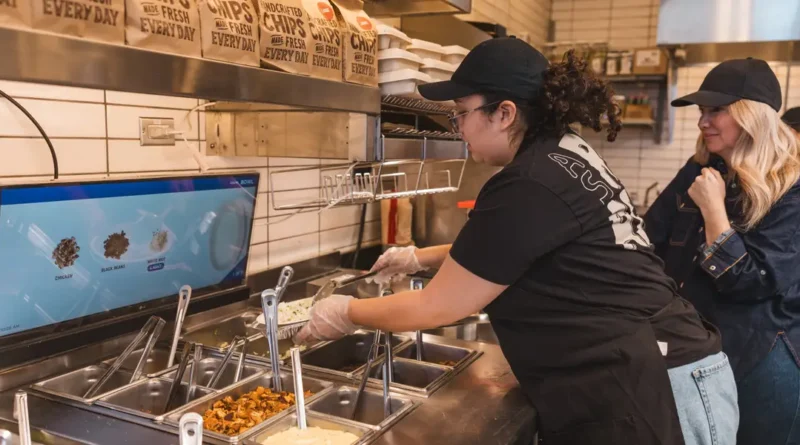
David McNew/Getty Images
The second project is my favorite.
Every morning, Chipotle managers face a deceptively difficult question: How much food should we prepare?
Too little chicken or guacamole, and customers may be disappointed. Too much, and food gets wasted.
Traditionally, managers arrive around 7 am, consult historical sales figures, and work through their plans by hand, often using clipboards and calculators.
But last year’s sales figures don’t necessarily tell you what’s going to happen today.
A restaurant near a college campus might get a sudden rush when classes finish at 10:50 am. Another location might be busiest at 12:30 pm.
Weather, local events, and promotions can also change demand.
Even the size of avocados varies throughout the year, depending on where they’re grown.
“Wait a minute, wait a minute,” I interrupted Sisson when she mentioned this during our interview.
Yes, apparently avocado sizes are another thing restaurant managers have to worry about.
Chipotle’s answer is an AI system called Cook to Needs.
It analyzes demand and recommends how much fresh food each restaurant should prepare throughout the day.
Consider Chipotle’s promotion offering free chips and guacamole to new rewards members. That changes how many avocados restaurants need. But because it’s a new promotion, last year’s sales figures won’t capture the extra demand.
AI can help account for that change, along with local conditions and other factors, so restaurants are better prepared.
The system is being tested at 500 locations, with plans to expand nationally.
Sisson said the old manual processes could consume hours each day. Chipotle hasn’t provided a precise figure for how much time Cook to Needs saves, but the company is already seeing encouraging results.
Restaurants that use the system most consistently report higher customer satisfaction and fewer complaints than those that use it less frequently, according to Chipotle.
The company is also tracking food waste, preparation time, and the efficiency with which employees are deployed.
There’s an important financial opportunity here: Less wasted food saves money, while having enough fresh ingredients on hand can help prevent lost sales.
An AI assistant for restaurant bosses
The third project brings these ideas together.
Chipotle is developing an AI assistant specifically for general managers.
Imagine arriving at work and asking what you need to know about the day ahead.
The assistant could flag a large catering order, warn about an unusual staffing situation, or explain how a local sporting event might affect customer traffic.
It could also help managers find answers to routine questions about restaurant procedures without having to dig through documents.
The system is in an early testing phase.
Chipotle plans to make these tools available on mobile tablets, so managers can use them while moving around their restaurants rather than sitting in an office.
The idea is to give managers the information they need without making them spend hours finding and analyzing it.
The human payoff
There’s a bigger point here that goes beyond burritos and guacamole.
Companies are spending enormous sums on AI, and investors increasingly want to know whether the technology is actually delivering a financial return.
Chipotle’s experience suggests that some of the most useful applications are relatively mundane. Hiring people faster. Preparing the right amount of food. Helping managers make better decisions.
Those improvements can translate into lower costs, higher sales, and more productive employees.
But there’s another benefit that’s harder to measure.
A manager who spends less time staring at spreadsheets can spend more time training employees, solving problems, and helping customers.
Sisson, who previously worked at hotel companies including Marriott and Hyatt, sees this as a return to the basics of hospitality.
She doesn’t approach AI primarily as a way to eliminate jobs. Instead, she wants to change what employees spend their time doing.
“I don’t think anyone goes into a general manager job because they’re like, ‘I love spreadsheets and check boxes,'” she told me.
I couldn’t agree more. I don’t like spreadsheets either.
Sisson describes restaurant managers as coaches and quarterbacks. Their real value comes from leading people, especially during the frantic lunch and dinner rushes.
And that’s perhaps the most interesting lesson from Chipotle’s AI experiments.
The technology is doing more of the boring work so people can concentrate on the human stuff.
Or, as Sisson put it: “If a tool doesn’t make that crew member’s day easier, it doesn’t matter how cool it is, how much AI is in it.”
Sign up for the AI Insider newsletter here. Reach out to me via email at abarr@businessinsider.com