
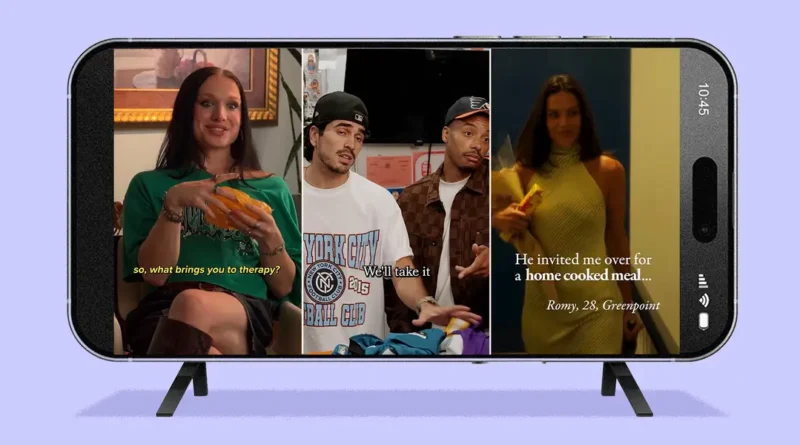
The golden age of social sitcoms has arrived
The best new television I’m watching isn’t on HBO or Netflix. It’s on Instagram.
Flipping through channels — ahem, I mean, scrolling through my Instagram feed — I’ve found myself tuning into episodes of a new generation of sitcoms. There’s “Brooklyn Coffee Shop,” where two deadpan baristas face stereotypical New York City customers. Then there’s “The Ick,” where real-life submissions of dating mishaps are acted out in roughly a minute or less.
There may not be a laugh track, but the new comedy shows taking over social media feeds are reinventing the banter of the television sitcom to fit into short-form, vertical video slots.
For me, landing on a sitcom in the algorithm is a welcome escape from a barrage of AI slop, podcast clips, and ads.
A break is “what a lot of people are looking for,” says Jourdain Fisher, a longtime comedian and co-creator of the weekly show “Secondhand Exchange.” They’re seeking out laughter and levity.
Courtesy of Secondhand Exchange
Fisher and his co-creator, Max Manticof, published the first episode of “Secondhand Exchange” in June. The two play fictional employees at a New York City thrift store, bantering with drop-in customers — typically other comedians like “Saturday Night Live” stars Tommy Brennan and Kam Patterson — before buying the secondhand drop-offs. Each three-minute episode ends with either Fisher or Manticof saying “we’ll take it.”
In less than five months and with 24 episodes, the Instagram page for the short-form sitcom has racked up 130,000 followers and 17 million views.
It’s part of a cresting wave of Instagram shows.
Jon Stahl, a producer who has been in the TV industry for over a decade and worked on sitcoms like “Veep,” has closely tracked the format’s rise. According to Stahl’s analysis of 34 scripted short-form shows on Instagram, the niche has collectively drawn over 1.4 billion views since 2023. The number of episodes is ramping up, too. Stahl tracked 44 short-form sitcom episodes released in October 2025, which tripled to 136 in October 2026.
The rise of short-form sitcoms is part of what Adam Wescott, CEO of Mind Chatter Media, calls the “cable-ification” of social media. Slowly but surely, the creator economy has spread into genres that were once staples of cable TV. There are late-night television replacements (like Kareem Rahma‘s “Subway Takes”), daytime talk shows (like the many man-on-the-street interview series), and reality TV (like Fallen Media’s dating show “Street Hearts“). Soap operas have been reborn as “micro dramas,” which have taken off on TikTok.
Screenshots/Instagram/Brooklyn Coffee Shop; The Ick
Social media and TV are increasingly blurred. It’s all “entertainment,” said Jon Henson, director of talent and media development at Underscore Talent.
Proving scripted short-form content can be a stable business is the industry’s next hurdle.
“We knew that we could make enough money to stay afloat doing commercial work and branded series because those things had taken off,” said Ari Cagan, cofounder of American Picture Company, which produces “The Ick.” “The white whale, so to speak, was scripted.”
Scripted shows require more planning, hiring talent, and higher production costs than typical unscripted social shows. Some shows, like “The Ick,” are finding early success with brand sponsorships fueling the business. Others are scrappily self-funding their shows in hopes of selling their series to studios or streaming platforms.
The making of a social sitcom
Stahl isn’t just tracking social sitcom shows; he’s making them.
He’s produced five scripted social series since February 2025, “two of which went nowhere,” two that are still in production, and one that’s become an instant hit.
In August, Stahl put out the first episode of “Near Death,” which follows a revolving cast of people who’ve experienced near-death experiences and have to face “Death” himself, played by “Veep” actor Matt Walsh. The show got 10 million views across Instagram and Facebook in about a month.
There’s a successful social sitcom recipe here: A main character (sometimes two) experiences different iterations of more-or-less the same situation.
It’s what has worked for “Brooklyn Coffee Shop,” where the baristas, played by Pooja Tripathi and Darryl Gene Daughtry Jr., interact with a new customer each episode, as well as for “Secondhand Exchange,” Elliott Walker’s “Time Travel Department,” and Mutuals Media’s “Gen Z Therapist.”
Courtesy of Mutuals Media
The “repeatability,” Stahl said, is what makes the format so moldable to social media. Crews can shoot episodes in bulk, and familiar sets and characters signal to viewers that they’ve been there before. That “recognizability,” said Mutuals Media‘s CEO Amelia Montooth, is critical in getting “people past the three-second mark where you lose half your audience.”
Other successful styles include slice-of-life vignettes, such as “The Ick,” or Jonah Feingold’s “Flirting!” series, which follows two people through a flirtatious exchange.
Courtesy of Jonah Feingold
“We’re working on our version of micro dramas, but we don’t call them that,” Feingold said. “We call them romantic-coms, and they are basically if you made ‘You’ve Got Mail’ today and released it on your phone.”
In part, these shows are successful on social media because the algorithm echoes our old habit of flipping through TV channels. If you land on one of these shows, you don’t need to know the whole context or what happened last week. You can drop in, laugh, leave, and pray that the algorithm will deliver the content to you again.
“Every episode can be someone’s first,” said NowThis editor in chief Michael Vito Valentino. “That shapes everything from the writing to the pacing, because each episode is both a story and a potential entry point into the series.”
Short-form sitcoms are on the rise
Audience size matters to these sitcoms as much as it does for cable television.
However, there’s an added layer of engagement that gauges a show’s success: comments and shares. For example, the most viral episode of “Brooklyn Coffee Shop” — a crossover episode with another show, “Mechanical Pencil” — has over 10 million views, 13,000 comments, and 267,000 shares.
“If something is very shareable, that’s how we know it’s sticking,” said Fallen Media’s Rowan Winch.
Replacing the pilot
With viral episodes and a loyal, returning audience, creators hope to prove their show’s worthiness to studios.
“This is going to be the new pilot model for comedy TV shows,” Stahl said.
Courtesy of Near Death
It’s happened before.
In the 2010s, with the rise of YouTube and video platforms like Vimeo, web series emerged as a new breeding ground for television hits. HBO tapped web show creators like Ben Sinclair (“High Maintenance”) and Issa Rae (“Insecure”), while Comedy Central picked up a series by Abbi Jacobson and Ilana Glazer (“Broad City”).
Now the second wave is coming. This time, it’s short-form creators who have been trained by the TikTok algorithm.
Streaming companies and studios are tapping in.
Last week, streaming platform Tubi announced the cohort of 10 creator-made shows from its partnership with TikTok. The shows, which will premiere exclusively on Tubi, will be longer-form and are an effort to showcase the talent coming out of TikTok.
“We look for creators who have built something people are already invested in, whether that’s a world, a set of characters or a format, that keeps fans coming back,” said Tubi’s VP of creator partnerships, Kudzi Chikumbu.
In October, Netflix also debuted “Minimum Wage,” a new sitcom that began as a web series from the short-form comedy troupe American High starring new “SNL” member Grace Reiter.
Netflix
Underscore’s Henson said part of the talent management firm’s job is now helping its creator clients develop their shows, build an audience, and open up “Hollywood opportunities.” Underscore represents several scripted shows, including “Brooklyn Coffee Shop,” “Eavesdropping,” and “Time Travel Department.”
For creators like Manticof, a successful social sitcom proves “the work we can do on a production level.”
Comedy is a creator business
Short-form sitcom creators have a major (and perhaps not surprising) obstacle: making money.
“It’s hard to monetize, but it’s not impossible,” American Picture Company’s Cagan said.
There are monetization options available across platforms like Instagram, Facebook, YouTube, and TikTok, but short-form video pays a lot less than long-form.
“We do monetize on YouTube,” said Feingold, but it’s not enough to fuel a business. “I can buy somebody lunch.”
Courtesy of Jonah Feingold
Instagram, where the majority of these shows are seeing recent success and growth, also has limited monetization capabilities. As the platform expands into more long-form video and funds some creators directly, the company has said it is exploring more options.
Some shows are turning to paywalled content on Patreon, like “Eavesdropping,” which offers fans early access and exclusive episodes, or on Substack, where “The Ick” shares paywalled short stories about people’s dating icks. Others sell merch, like Jay Renshaw’s show “Chit.”
Most shows are turning to the prime engine of the creator economy: brand deals.
Cagan’s company works directly with brands on projects and occasionally shares sponsored posts on the “The Ick” account. Feingold has also worked with brands like Valentino on an episode of “Flirting!” while “Brooklyn Coffee Shop” has worked with brands like Tory Burch on an episode.
Several industry insiders who spoke with Business Insider described seeing brand deals for short-form scripted shows that ranged from $10,000 to $100,000, with larger shows and more deliverables pushing budgets into the six figures.
Brands want their own shows, too.
Banana Republic
Last year, fintech company Bilt developed “Roomies,” a weekly sitcom about four New York roommates, in-house as its own branded show. Aeropostale launched a new season of “The Intern Diaries” this summer, starring Deja Clark. The show follows new interns in the style of “The Office.” In October, Banana Republic released a five-episode short-form sitcom starring TikTok star Jack Innanen, who also stars in the popular FX comedy “Adults.” Its few episodes are getting millions of views on both Instagram and TikTok.
“Brands know that there’s attention to be had here,” Stahl said.
Working with brands pays the bills, but social sitcom creators still have a bigger goal in sight. Social shows are an “incubator,” Wescott said.
The goal for many social sitcoms is to “prove the appetite for specific IP, characters, different personalities and actors” at a “lower cost,” Wescott added. Expansion, derivatives, and streaming opportunities come later.