
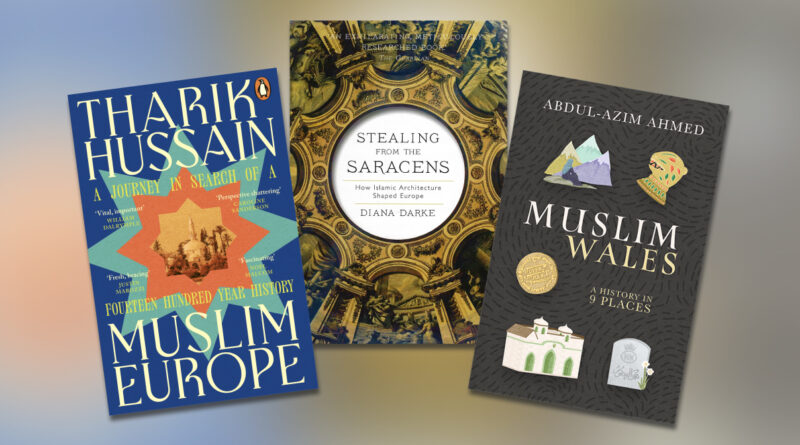
Three books on Islamic European history you must read
In the name of Allah, the Most Gracious, the Most Merciful. All praise is due to Him, and may His peace and blessings be upon His final Messenger, Muhammad.
Europe is a continent with a deep Islamic history stretching back as far as the Sahaba (radiy Allahu ‘anhum). But sadly, many British and other European Muslims are unaware of these links. This leaves our brothers and sisters, especially the youth, at the mercy of bad faith actors, from Islamophobes to the far right, who would have them believe that they have no ties to their region of birth and/or residence.
As the historian and playwright Howard Zinn put it,
History is important. If you don’t know history, it is as if you were born yesterday. And if you were born yesterday, anybody up there in a position of power can tell you anything, and you have no way of checking up on it.”
This is a state of affairs that our communities ignore at our own peril. Understanding one’s history is important to an individual’s sense of self. It can help nurture the confidence of our younger generations. Feeling grounded, as part of the European mosaic, is essential if our communities are to truly meet their potential and drive positive changes for our wider societies and the Ummah at home and abroad.
To that end, here is a brief recommended reading list of three history books one can start with:
Muslim Wales: A History in 9 Places (2026) by Dr. Abdul-Azim Ahmed
Published this year, Muslim Wales takes readers on a charming tour across Wales and the surrounding areas. Along the way, the author, Abdul-Azim Ahmed — who serves as Deputy Director of the Centre for the Study of Islam in the UK at Cardiff University, and Secretary General of the Muslim Council of Wales — unpacks fascinating and longstanding Muslim connections to these places, many of which may come as a surprise.
Who would have thought, for instance, that the earliest record of a Welsh Muslim would be from the year 1671? The book is full of such gems, exploring the life of Britain’s first ālim, Lord Stanley (1827-1903), the story of the Yemeni Shaykh Abdullah Ali al-Hakimi and the sailors who established one of the UK’s oldest Muslim communities in Cardiff, not to mention how Wales came to Sylhet, but also how Sylhet came to Wales.
Beyond the historical surprises, another striking feature of the book is the clear affection with which it is written. Abdul-Azim — in my view, likely the world’s foremost expert on the Islamic history of Wales — writes the book as a love letter to his homeland, a place in which his religious and national identities are not contradictory but rather naturally compatible… dare I say complementary.
The book is perhaps best summarised in the words of a Punjabi Muslim soldier stationed in Wales during the Second World War, who described a trip to the north Welsh seaside as “happy, interesting, educative, and binding”. Any understanding of British Muslim history is incomplete without this book.
Muslim Europe: A Journey in Search of a Fourteen Hundred Year History by Tharik Hussain (hardback: 2025, paperback: 5 November 2026)
My next recommendation is another adventure, but traversing a much larger distance! Muslim Europe follows the East London-based travel writer, historian, and author Tharik Hussain from Cyprus to Spain, with stops in Sicily, Malta, and Portugal as he sheds light on a variety of Islamic heritage and history, starting with the arrival of the Sahabi Muawiyah (radiy Allahu ‘anhu) on Cyprus around 647 CE, and the establishing of the first Muslim navy, all the way to the end of Muslim rule in Spain with the fall of Granada in 1492.
The book’s references to the Sahaba (radiy Allahu ‘anhum), especially to figures such as the aunt of the Prophet Muhammad ﷺ, Umm Haram bint Milhan (radiy Allahu ‘anha), who died on Cyprus — dubbed the “Grandmother of Muslim Europe” by Hussain — offers a critical starting point. Hussain makes the important point that since the first generation of followers of the Prophet ﷺ reached Europe, Islam is undoubtedly as European a religion as Christianity.
From this solid base, the book introduces readers to colourful characters, stories, and marvels, from the Arabic-speaking Norman kings of Sicily who lived like Christian sultans while ruling over Muslims, Jews, and Christians, to a blue-eyed, red-haired caliph holding sway over much of Iberia and parts of north Africa from Cordoba.
Tharik highlights fascinating quirks, including the Maltese language being rooted in Arabic, the Portuguese Christians of Mertola who prayed towards Makkah, and the Spanish synagogues inspired by Islamic architecture that remind us the Jewish Golden Age took place in Muslim Europe. Collectively they point to a cosmopolitan and shared history, relevant to all Europeans.
Stealing from the Saracens: How Islamic Architecture Shaped Europe (2020) by Diana Darke
My final recommendation is one that has the power to change how Muslims in Europe see their surroundings — for the better! Stealing from the Saracens, by the author, Arabist, and Middle East cultural expert Diana Darke, uses architecture to remind readers of the immense cultural debt that the Western world owes to Islamic civilisation, a contribution that is all too often unknown, ignored, or at worst, wilfully erased.
The book explores how many of Europe’s most beloved monuments, particularly those built in the medieval Gothic and Romanesque styles (among others), are heavily influenced by historic architecture found throughout the Middle East and North Africa, tracing their entry into Europe through long periods of Islamic rule in Iberia and Sicily, as well as through crusaders, merchants, pilgrims, and craftsmen.
Diana shows how Islamic-style domes, windows, and a variety of arches (to name only a few features) influenced many famous buildings. Some of these include UK examples like St Paul’s Cathedral, the Houses of Parliament, and Bradford Wool Exchange, as well as others abroad like Paris’ Notre Dame, and even St Mark’s Cathedral in Venice. Best of all, the book can train your eyes and make these features easy to spot. I remember admiring the Egyptian Mamluk-style windows on an East London church from my seat on an Overground train just the other day.
In a comical way, Stealing from the Saracens reminds me of the 2002 film My Big Fat Greek Wedding, where Gus, father of the bride, “finds” Greek origin in all sorts of things, from the Japanese word “kimono” to the last name Miller. But this time, architectural feature after architectural feature is traced back to various Islamic civilisations, and you can rest assured that the book is far more thoroughly researched than any of Gus’ claims!
Humour aside, Stealing from the Saracens offers readers a fantastic opportunity to remember Europe’s Islamic heritage on a daily basis, simply by looking around them.
I hope you’ve enjoyed my recommendations and will go on to give them a read if you haven’t already. Lastly, don’t forget to keep these authors in your du’ā.
Source: Islam21c
![[Podcast] Faith, Motherhood, and the Call to Gaza | Dr. Samaiya Mushtaq](https://themuslimpress.com/wp-content/uploads/2026/09/Podcast-Faith-Motherhood-and-the-Call-to-Gaza-Dr-390x205.png)